
Guides
Why do all my snack ratings end up at four or five stars?
When broad ratings stop separating your favorites, compare products for the same occasion and keep a note explaining the preference.
By finds editorial · 3 min read ·
Your top ratings may be doing one broad job: saying you enjoyed the food. To distinguish favorites, ask a second question: which would you choose again? A personal ranking can separate two liked snacks without pretending one was disappointing. In finds, comparisons help turn broad reactions into an order.
A positive rating is not a complete ordering
Imagine you tried three cookies and enjoyed all of them. Giving each a high rating may accurately capture that reaction. The missing information is what happens when you only want to buy one package.
That is not necessarily a broken rating system. It may mean your rating answers “did I like it?” while your shopping decision asks “which do I prefer?” Keep both answers rather than lowering a score just to make the chart look varied.
Try a pairwise question
Pick two foods you remember well. Ask which you would choose for the same occasion tomorrow. Then write the difference that decided it: texture, flavor intensity, portion format or another detail from your own experience.
| Record | What it tells you |
|---|---|
| A broad positive reaction | You enjoyed the product |
| A personal rank | Its position among the products you compared |
| A short note | Why that position makes sense to you |
| An untasted saved item | Something you may try, with no verdict yet |
Do not compare a favorite because it has a larger package or a current discount unless that is explicitly part of your question. Taste, convenience and value can all matter, but they should not silently change places.
Use the existing evidence carefully
In our snack-rating guide, an editor marked two cheese snacks positively while ranking one above the other. That example belongs to one person. It demonstrates the distinction without claiming everyone would agree.
The feature image on this page shows a comparison prompt. Its illustrative notes are not extra tasting evidence for the foods pictured.
You do not need a perfect ladder
If you cannot remember a product, do not force an answer. If two foods serve different jobs, explain the context. And if your list changes after another tasting, that can reflect a larger set of comparisons rather than a dramatic reversal.
The useful result is a record that helps you choose again. Start with the ranking walkthrough, or use the two-flavor comparison card when the difference is hard to describe.
This is a practical note-taking approach, not a claim about the accuracy of any rating algorithm.
See the feature
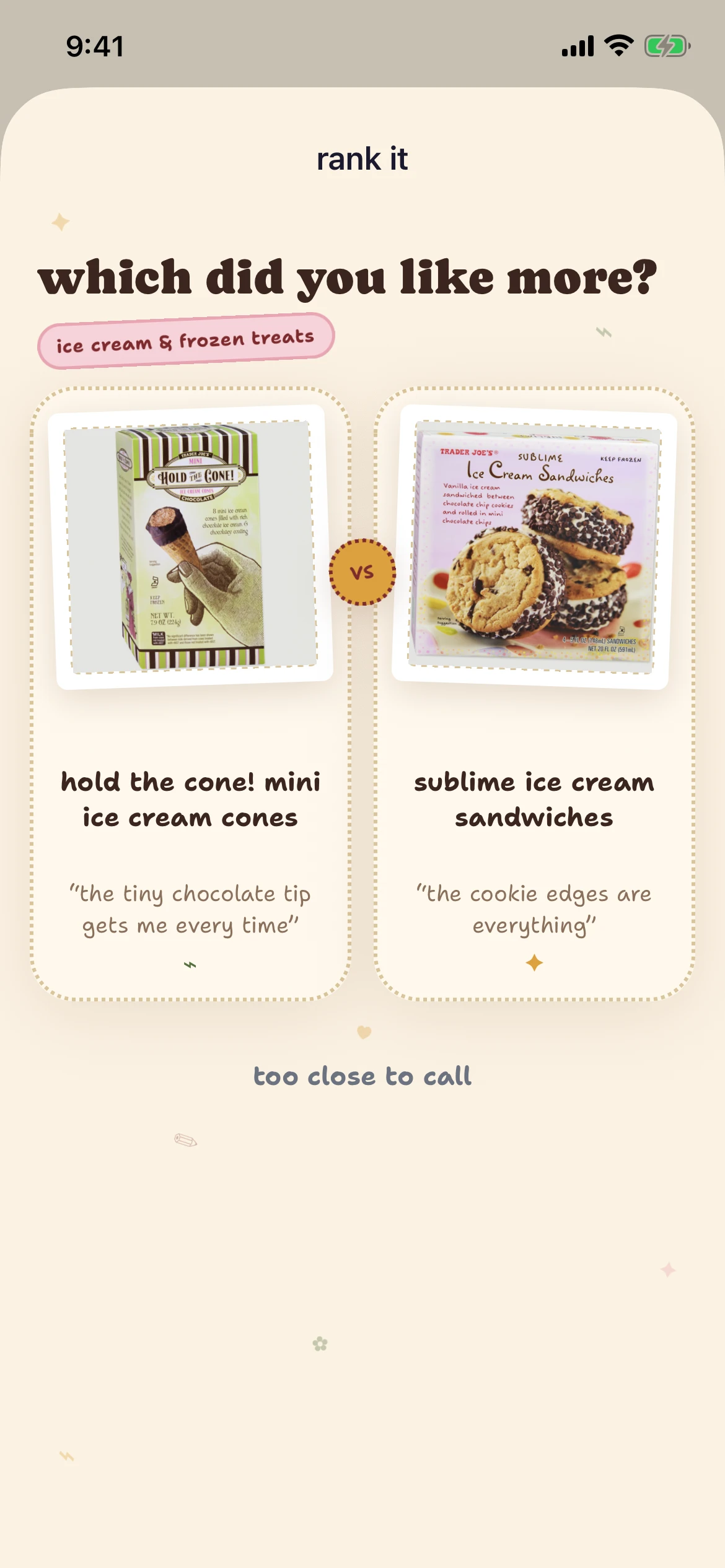
Illustrative finds comparison screen. The displayed notes demonstrate the feature and are not tasting evidence for this article.